
Printed Electronics Projects
Our dedication to innovation is tireless, and is also reflected in the R&D projects in which we participate. These projects allow us to develop unique and personalized solutions for a wide variety of applications and markets, allowing us to be at the forefront in the field of printed electronics.
H-LEAF
NEW H-LEAF TECHNOLOGY FOR GREEN HYDROGEN GENERATION
Project objective
The H-LEAF project focused its efforts on researching and developing advanced green hydrogen production technologies with more sustainable and scalable processes, reducing costs and improving energy efficiency.

Consortium Capabilities
Rotimpres, a manufacturer specializing in printed electronics, was part of the consortium, contributing its expertise in advanced industrial printing processes and functional materials. The team worked alongside technology partners in the design of key components for electrolysis.
Solution to the challenge
H-LEAF addressed the current limitations of traditional electrolysers by developing new electrode, membrane, and material designs with a lower environmental impact, employing industrial printing techniques that enable sustainable and scalable processes. Furthermore, the use of problematic chemicals (such as PFAS) was eliminated to improve the safety and economic viability of hydrogen production.
Programa i convocatòria
Projecte finançat pel Ministeri de Ciència, Innovació i Universitats a través de la convocatòria del programa «Misiones de Ciencia e Innovación» en el marc d’iniciativa «Transmisiones 2023»
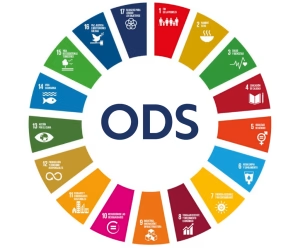
ODS relacionats
6. Aigua neta i sanejament
7. Energia assequible i no contaminant
8. Treball decent i creixement econòmic
9. Indústria, innovació i infraestructura
11. Ciutats i comunitats sostenibles
12. Producció i consum responsables
13. Acció pel clima
17. Aliances per assolir els objectius
Project Scope
The initiative included innovation in components such as bipolar plates manufactured using technologies like stainless steel stamping and 3D printing with recycled titanium powder, as well as advanced coatings for corrosion protection. Improvements in auxiliary systems such as hydrogen compression were also explored.
Expected outcome
The project is aimed at producing a functional PEM electrolyzer demonstrator with a power output of up to 1 kW, validated on a test bench, reaching a technology readiness level (TRL) of 6. This solution is expected to drive the transition to clean energy and position Spain as a leader in emerging sustainable hydrogen technologies.
