
From Rigid to Flexible: How Roll-to-Roll Manufacturing Is Transforming Electronics
For decades, electronics were limited by the constraints of rigid components and traditional assembly methods. Circuit boards, discrete modules, and fixed geometries dictated not only how products were built but also how they could function. Designing around rigid electronics meant compromises — in form, size or integration — that restricted innovation.
Today, roll-to-roll (R2R) manufacturing is redefining what is possible. By combining additive printing techniques with flexible substrates, R2R allows electronic circuits to be produced continuously on rolls of material, just as a newspaper is printed. This approach enables electronics that are ultra-thin, adaptable and fully integrated into the product surface, rather than being added as separate components.
The technology behind roll-to-roll
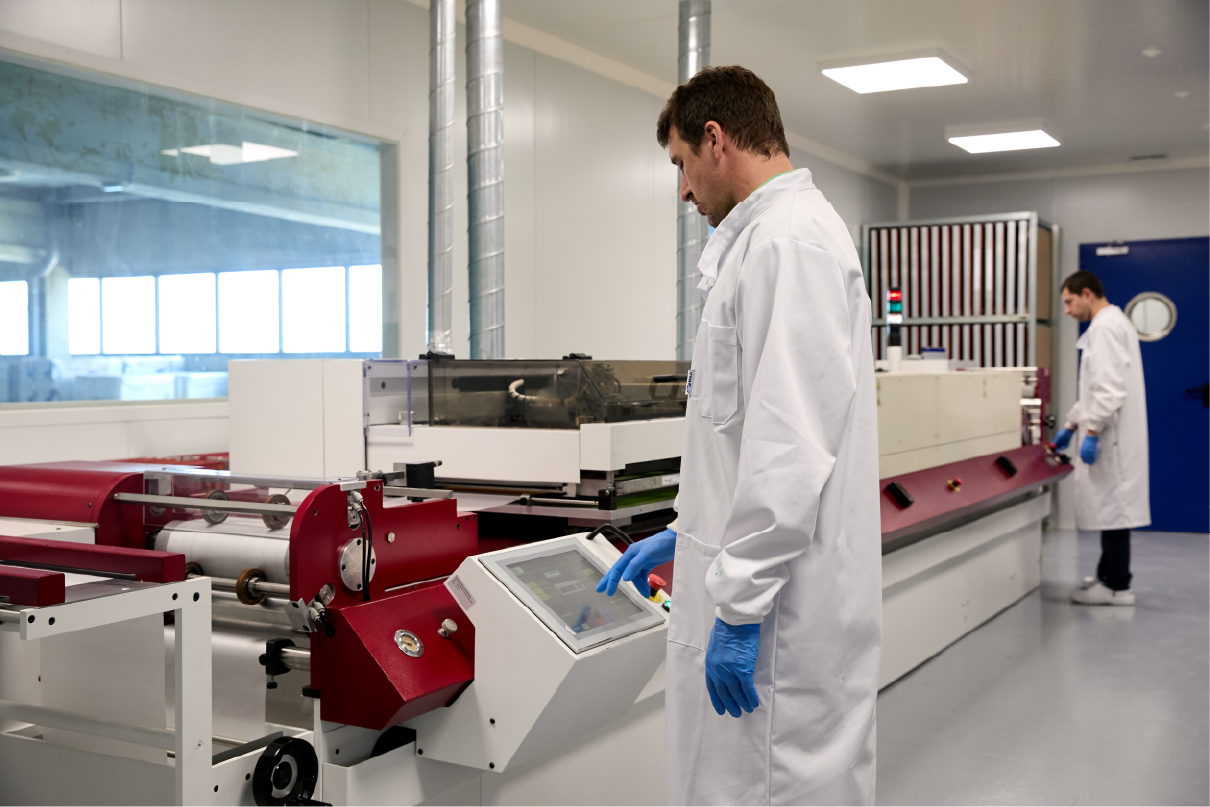
Roll-to-roll is an industrial printing method that deposits functional materials — such as conductive inks — onto flexible substrates in a continuous, high-throughput process. Unlike traditional subtractive methods that carve circuits out of rigid boards, R2R builds the circuit only where it’s needed, layer by layer, with exceptional precision.
This enables several key advantages:
- Continuous, high-volume production – Circuits are printed along meters of substrate, eliminating bottlenecks and reducing labor-intensive assembly steps
- Precision and repeatability – Layer thickness, line width and conductivity are tightly controlled, ensuring consistent performance across long production runs
- Material efficiency – Conductive inks are deposited only where required, minimizing waste and energy use compared to conventional electronics fabrication
- Form factor flexibility – Electronics can follow curves, edges or irregular surfaces without additional mechanical modifications
In short, R2R allows manufacturers to produce functional, flexible electronics at industrial scale, bridging the gap between lab prototypes and commercial-ready products.
Impact on product design and innovation
The shift to roll-to-roll printed electronics fundamentally changes how designers and engineers approach product development. Electronics no longer constrain form and function; instead, they adapt to the product. This opens new opportunities across industries:
- Integration into unconventional surfaces: Circuits can be embedded into fabrics, plastics or even paper, enabling interactive packaging, wearable sensors or flexible user interfaces
- Miniaturization and weight reduction: Without rigid boards and discrete components, devices can be lighter, thinner and more ergonomic
- Rapid iteration and customization: Because R2R is an additive process, designs can be quickly modified without the need for expensive tooling changes, allowing faster product development cycles
Perhaps most importantly, R2R allows innovations that were previously limited to prototypes to scale industrially. A lab-printed sensor that only worked on a small patch can now be produced across kilometers of substrate with consistent performance.
Thinex Rotimpres: leveraging roll-to-roll at industrial scale
At Thinex Rotimpres, roll-to-roll manufacturing is at the core of our approach to flexible electronics. By combining high-precision R2R printing with advanced materials and in-line quality control, we can deliver solutions that are:
- Scalable – From pilot runs to full industrial volumes
- Customizable – Circuits, sensors and interactive layers tailored to each project
- Reliable – Consistent electrical and mechanical performance across production
Our R2R capabilities enable us to co-create products where electronics become functional layers integrated directly into surfaces. Examples include printed sensors for pressure or temperature monitoring, flexible heaters embedded in textiles and capacitive touch interfaces on curved panels — all produced continuously and at industrial scale.
The impact of R2R goes beyond mere manufacturing efficiency. By enabling electronics to conform to products rather than forcing products to conform to electronics, it reshapes the possibilities for industrial design, human-machine interaction and product innovation. Companies can now explore entirely new geometries, functionalities and user experiences — without the constraints of rigid components or assembly complexity.
Roll-to-roll manufacturing represents a shift not just in production, but in how electronics are conceived, designed and deployed. By making electronics flexible, scalable and adaptable, R2R unlocks a new class of products where functionality is integrated seamlessly, performance is consistent and production can meet industrial demands.
At Thinex Rotimpres, our mission is to leverage roll-to-roll printing to turn innovative concepts into market-ready products, bridging the gap between research, prototyping and industrialization. This technology enables industries to move beyond rigid electronics, creating devices that are more intuitive, efficient and ready for the future of connected, intelligent products.
The transition from rigid to flexible electronics is not incremental — it is transformative. And with roll-to-roll manufacturing at the center, Thinex Rotimpres is helping industries scale this transformation, delivering electronics that are as adaptable as the products they inhabit.
