
From Rigid to Flexible: How Roll-to-Roll Manufacturing Is Transforming Electronics
For decades, electronics were limited by the constraints of rigid components and traditional assembly methods. Circuit boards, discrete modules, and fixed geometries dictated not only how products were built but also how they could function. Designing around rigid electronics meant compromises — in form, size or integration — that restricted innovation.
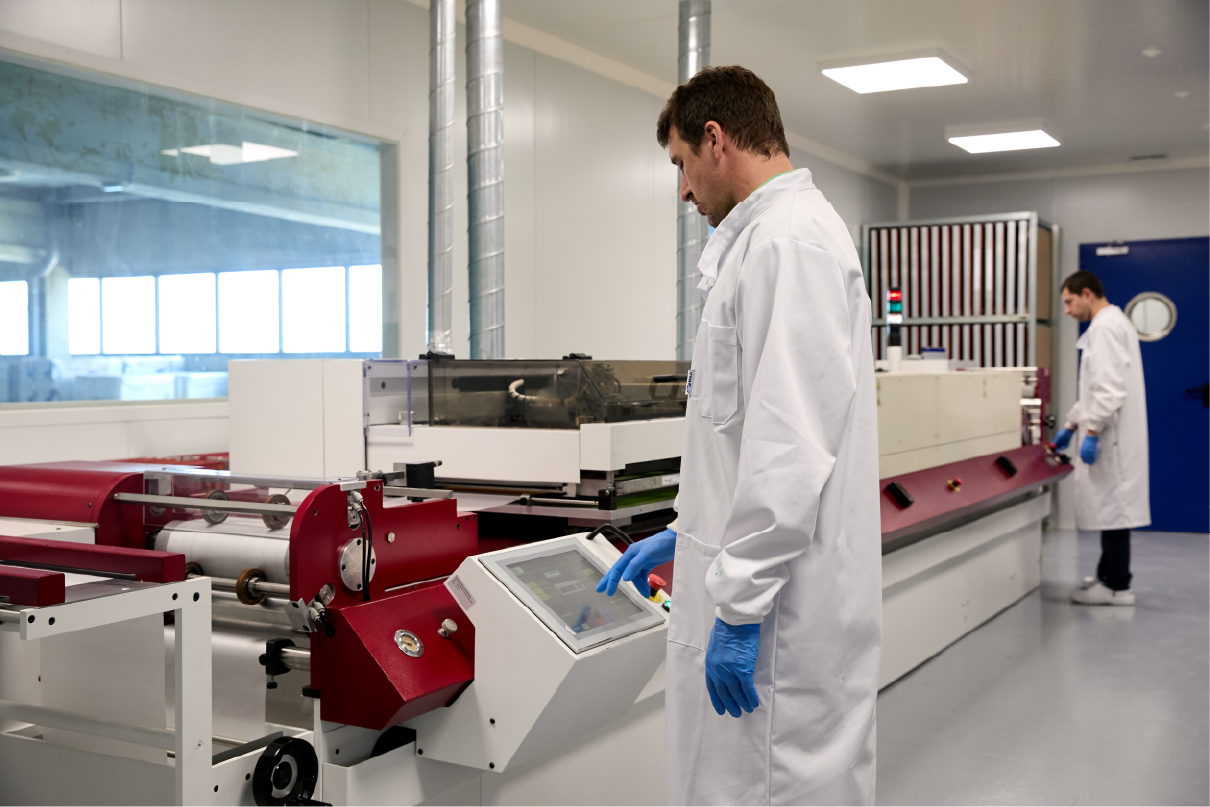
Today, roll-to-roll (R2R) manufacturing is redefining what is possible. By combining additive printing techniques with flexible substrates, R2R allows electronic circuits to be produced continuously on rolls of material, just as a newspaper is printed. This approach enables electronics that are ultra-thin, adaptable and fully integrated into the product surface, rather than being added as separate components.
The technology behind roll-to-roll
Roll-to-roll is an industrial printing method that deposits functional materials — such as conductive inks — onto flexible substrates in a continuous, high-throughput process. Unlike traditional subtractive methods that carve circuits out of rigid boards, R2R builds the circuit only where it’s needed, layer by layer, with exceptional precision.
This enables several key advantages:
- Continuous, high-volume production – Circuits are printed along meters of substrate, eliminating bottlenecks and reducing labor-intensive assembly steps
- Precision and repeatability – Layer thickness, line width and conductivity are tightly controlled, ensuring consistent performance across long production runs
- Material efficiency – Conductive inks are deposited only where required, minimizing waste and energy use compared to conventional electronics fabrication
- Form factor flexibility – Electronics can follow curves, edges or irregular surfaces without additional mechanical modifications
In short, R2R allows manufacturers to produce functional, flexible electronics at industrial scale, bridging the gap between lab prototypes and commercial-ready products.
Impact on product design and innovation
The shift to roll-to-roll printed electronics fundamentally changes how designers and engineers approach product development. Electronics no longer constrain form and function; instead, they adapt to the product. This opens new opportunities across industries:
- Integration into unconventional surfaces: Circuits can be embedded into fabrics, plastics or even paper, enabling interactive packaging, wearable sensors or flexible user interfaces
- Miniaturization and weight reduction: Without rigid boards and discrete components, devices can be lighter, thinner and more ergonomic
- Rapid iteration and customization: Because R2R is an additive process, designs can be quickly modified without the need for expensive tooling changes, allowing faster product development cycles
Perhaps most importantly, R2R allows innovations that were previously limited to prototypes to scale industrially. A lab-printed sensor that only worked on a small patch can now be produced across kilometers of substrate with consistent performance.
Thinex Rotimpres: leveraging roll-to-roll at industrial scale
At Thinex Rotimpres, roll-to-roll manufacturing is at the core of our approach to flexible electronics. By combining high-precision R2R printing with advanced materials and in-line quality control, we can deliver solutions that are:
- Scalable – From pilot runs to full industrial volumes
- Customizable – Circuits, sensors and interactive layers tailored to each project
- Reliable – Consistent electrical and mechanical performance across production
Our R2R capabilities enable us to co-create products where electronics become functional layers integrated directly into surfaces. Examples include printed sensors for pressure or temperature monitoring, flexible heaters embedded in textiles and capacitive touch interfaces on curved panels — all produced continuously and at industrial scale.
The impact of R2R goes beyond mere manufacturing efficiency. By enabling electronics to conform to products rather than forcing products to conform to electronics, it reshapes the possibilities for industrial design, human-machine interaction and product innovation. Companies can now explore entirely new geometries, functionalities and user experiences — without the constraints of rigid components or assembly complexity.
Roll-to-roll manufacturing represents a shift not just in production, but in how electronics are conceived, designed and deployed. By making electronics flexible, scalable and adaptable, R2R unlocks a new class of products where functionality is integrated seamlessly, performance is consistent and production can meet industrial demands.
At Thinex Rotimpres, our mission is to leverage roll-to-roll printing to turn innovative concepts into market-ready products, bridging the gap between research, prototyping and industrialization. This technology enables industries to move beyond rigid electronics, creating devices that are more intuitive, efficient and ready for the future of connected, intelligent products.
The transition from rigid to flexible electronics is not incremental — it is transformative. And with roll-to-roll manufacturing at the center, Thinex Rotimpres is helping industries scale this transformation, delivering electronics that are as adaptable as the products they inhabit.

How Printed Electronics Are Powering the Sustainable Revolution in Industry 4.0
The world is entering a new industrial era — one that’s smarter, cleaner, and more connected than ever before. Industry 4.0 is not only about automation or data; it’s about how we design, manufacture, and use products to create a more sustainable and intelligent future.
At the heart of this transformation lies printed electronics, a technology that allows electronic functionality to be printed directly onto materials such as paper, plastic, or textiles. By merging precision printing with advanced conductive materials, it enables ultra-thin, flexible components that integrate seamlessly into everyday products.
From packaging and mobility to healthcare and consumer goods, printed electronics are driving a quiet revolution — one that’s reshaping how industries think about efficiency, resource use, and circular design.
From Traditional Manufacturing to Sustainable Intelligence
Traditional electronics manufacturing has relied on rigid circuit boards, energy-intensive processes, and limited recyclability. Components are typically produced through subtractive methods that generate waste and restrict design flexibility.
As global industries face mounting pressure to achieve carbon neutrality and meet sustainability goals, these legacy systems are no longer enough.
Printed electronics mark a fundamental shift in how electronic functionality can be embedded into products. Using additive manufacturing, conductive inks are printed only where needed — minimizing material waste and enabling low-temperature, energy-efficient production.
A flexible printed sensor in a smart package can monitor temperature or humidity, improving supply chain efficiency and reducing food waste. A paper-based RFID tag can replace traditional plastic identifiers, creating fully recyclable smart packaging that enhances traceability and product authentication.

Materials and Design for Circularity
One of the most powerful aspects of printed electronics is how they align with the principles of the circular economy. Using biodegradable substrates, such as paper or compostable films, and recyclable conductive inks, manufacturers can reduce reliance on non-renewable materials while maintaining high performance.
At Thinex Rotimpres, this commitment to sustainable design is reflected in our paper-based solutions, which are biodegradable. These, replace plastic alternatives and help brands reach their ESG and circularity targets.
This same philosophy extends across our entire portfolio — from sensors that enable smarter resource management, to flexible heaters that optimize energy use in textiles or industrial applications, and biosensors that support more efficient and accessible healthcare. Each product is designed not only for functionality, but for long-term sustainability and scalability.
Beyond materials, printed electronics revolutionize the manufacturing process itself. Unlike conventional assembly lines, roll-to-roll (R2R) fabrication allows Thinex Rotimpres to produce electronic components continuously and efficiently, much like printing a newspaper.
This in-line, high-throughput production model significantly reduces energy consumption, increases speed, and enables large-scale customization without increasing environmental impact. It’s how scalability and sustainability converge — proving that responsible production can also be economically competitive.
Thinex Rotimpres: Where Innovation Meets Sustainability
As the printed electronics division of Rotimpres, Thinex combines over 40 years of industrial expertise in high-quality printing with a clear focus on sustainability and innovation. Our approach integrates R&D, design, and production under one roof, allowing us to deliver tailored solutions from concept to industrial scale.
By embedding intelligence directly into materials, Thinex Rotimpres enables companies to take a tangible step toward more sustainable, data-driven products that align with the values of Industry 4.0.
As industries worldwide move toward decarbonization, transparency, and circularity, printed electronics offer a viable path forward — one that transforms not just how products work, but how responsibly they are made.
At Thinex Rotimpres, we believe the future of Industry 4.0 is not just smarter — it’s more sustainable by design.
Discover how Thinex Rotimpres is shaping the next generation of smart, sustainable electronics at www.thinex.tech.
Printed Electronics for Space: Thinex Rotimpres Sensors Validated in NASA Parachute Testing
Parachutes are one of the most critical — and least forgiving — components of spacecraft landing systems. Their fabrics must withstand extreme aerodynamic loads while deploying perfectly in fractions of a second. Yet testing these systems on Earth is complex and expensive and engineers often rely on models that can’t fully capture what happens under real conditions.
To improve accuracy, NASA launched the study “Evaluation of Parachute Strain Sensor Adherence Effects on Ripstop Nylon Stiffness and Performance During Uniaxial Testing.”
The objective: determine whether printed strain sensors could measure stress directly on parachute fabrics without altering their mechanical properties. It was a challenge at the intersection of materials science and electronics — and one that called for precision, flexibility and innovation. That’s where Thinex Rotimpres entered the mission. Known for our expertise in functional printing and flexible electronics, we collaborated by developing ultra-thin printed strain sensors designed to conform perfectly to the delicate ripstop nylon used in parachutes. The goal was clear: enable in-situ measurement of strain and load while maintaining the fabric’s original performance.
Validating Innovation: The NASA Study
Traditional strain gauges can stiffen or weaken technical textiles — an unacceptable compromise in aerospace. Thinex’s approach relied on printed conductive inks deposited over Beyolex™ flexible substrates, forming standard strain gauge geometries only a fraction of a millimeter thick. This design provided excellent adhesion while preserving the mechanical elasticity and strength of the underlying material.
NASA engineers conducted rigorous uniaxial tests to compare control samples with fabrics that included sensors from both Thinex Rotimpres and Nitto Bend Technologies (NBT). The fabrics were stretched to failure under controlled conditions while measuring load, elongation, and stiffness.
The results were conclusive:
- The breaking load of the fabric remained unchanged.
- The load–strain curves for control and sensorized samples were nearly identical.
- Only a minimal effect on maximum elongation was detected — well within the acceptable performance range.
In short, the study confirmed that Thinex Rotimpes sensors could be integrated onto parachute fabrics without affecting their structural behavior. During low-speed uniaxial testing, they maintained the same mechanical response as unmodified material, validating that printed electronics can coexist with high-performance textiles in extreme applications.
For NASA, this meant more accurate data to validate parachute models and safety margins. For the broader scientific community, it was a step toward intelligent aerospace materials capable of self-monitoring in real time.
Beyond Space: A Step Forward in Intelligent Materials
The successful validation of our printed sensors in a NASA program reinforces what we believe at Thinex Rotimpres — that the future of electronics lies in integration, not addition. Instead of attaching bulky components to materials, we print intelligence directly onto them.
This capability opens up vast possibilities across industries:
- Sensors for pressure, humidity, strain and condensation that turn materials into data sources.
- RFID and NFC antennas that enable digital traceability in packaging and logistics.
- Touch interfaces and flexible heaters that improve comfort, efficiency and control in wearables or industrial applications.
- Biosensors that support remote and personalized healthcare.
Each design can be customized to meet specific needs — whether it’s measuring the mechanical stress on a parachute in Mars’ thin atmosphere or optimizing temperature distribution in a smart textile back on Earth.
At Thinex, we see this as more than a technical achievement. It’s a demonstration of how printed electronics can extend human capability, bridging the gap between physical materials and digital intelligence. By merging materials science, engineering and design, we’re shaping a future where surfaces themselves can sense, respond and communicate.
Our collaboration with NASA proves that innovation and precision printing can go hand in hand — even in the most demanding environments. From space missions to everyday applications, we continue to push what’s possible in flexible and sustainable electronics.
Discover more about our printed electronics capabilities
From Rigid Circuits to Smart, Adaptive Surfaces
Not long ago, most products with “smart” functionality relied on rigid, bulky electronics. Think of early smart watches that were thick and uncomfortable, packaging that required embedded chips for tracking, or wearables that restricted movement due to inflexible components.
Traditional electronics relied on printed circuit boards, soldered parts, and fixed form factors, forcing designers to adapt the product around the electronics rather than the other way around.
Why the Old Approach Was Limiting
For decades, electronics powered innovation — but traditional technology was built for rigidity, not adaptability. While functional, conventional components often forced compromises in design, efficiency and user experience. As products grew smarter and consumer expectations higher, these limitations became increasingly apparent.
Rigid form factors meant electronics had to be designed around the circuit boards, rather than the product itself. A luxury handbag or a flexible textile could not integrate electronics without sacrificing comfort or aesthetics. Subtractive manufacturing created excess material waste and energy-intensive processes. Slow iteration and prototyping made adding sensors or connectivity cumbersome. And everyday surfaces like paper, plastic or fabric could rarely become functional interfaces — consumers could not interact directly with most objects.
For businesses exploring new ways to innovate, this rigidity translated into higher costs, slower development and less sustainable products. Thinex Rotimpres recognized these challenges early and began pioneering Printed Electronics solutions that transform these limitations into opportunities.
How Printed Electronics Transforms Products
Printed electronics is a revolutionary technology that prints conductive materials directly onto flexible substrates such as paper, plastic, films, or textiles. Unlike traditional rigid electronics, it allows components to be ultra-thin, lightweight and fully adaptable, turning ordinary surfaces into intelligent, interactive and sustainable solutions. This flexibility enables designers to integrate intelligence into products in ways that were previously impossible, reducing material waste, energy consumption and assembly complexity.
En Thinex Rotimpres, damos vida a esta tecnología en una amplia variedad de aplicaciones
- RFID and NFC tags embedded in packaging or luxury goods allow instant authentication, track freshness and enable contactless access, improving security and consumer engagement.
- Sensors integrated into textiles, industrial tanks, or agricultural fields provide real-time data, optimizing resource use, monitoring health and preventing structural failures.
- Biosensors make diagnostics, environmental monitoring and food safety faster, more accessible and cost-effective.
- Capacitive keyboards and touch interfaces transform walls, tables and vending machines into sleek, low-energy and responsive surfaces.
- Flexible heaters deliver targeted warmth in wearables, protect batteries or prevent condensation — all without adding bulk or compromising design.
By embedding intelligence invisibly into everyday materials, Thinex Rotimpres turns ordinary objects into adaptive, connected and high-performing solutions. Discover our capabilities to see how we help clients across industries.

Looking Ahead: A Paradigm Shift in Product Innovation
The potential of Printed Electronics extends far beyond replacing rigid circuits. It redefines what products can do, how they can engage users and how sustainably they can be manufactured. Everyday objects — from packaging to wearables, industrial equipment to healthcare devices — can now sense, respond and adapt without compromising design, comfort or efficiency.
With Thinex Rotimpres, the invisible layer of intelligence becomes a tangible competitive advantage. Companies can create smarter, more sustainable and interactive products, turning bold ideas into market-ready innovations. Printed Electronics is more than a technological upgrade — it’s the future of product design, already being realized today.
By partnering with industry leaders like the Clúster MAV and other technology associations, Thinex Rotimpres stays at the forefront of innovation, driving adoption of advanced printed solutions worldwide.
Ready to rethink your products and embrace the future of Printed Electronics?
Transforming the Way Products Interact with the World
The physical world is going digital. Consumers expect products to sense, respond, connect and adapt – pushing industries to rethink how they create value.
At the heart of this shift lies printed electronics—an invisible layer that embeds intelligence directly into everyday surfaces. By printing conductive materials onto flexible substrates like paper, plastic, films, or textiles, printed electronics allows ultra-thin, lightweight high-performance components to blend seamlessly into their environment.

The Invisible Layer Powering Innovation and Sustainability
Two powerful forces are accelerating the adoption of printed electronics today:
- A hunger for smarter, connected products. From smart textiles to interactive packaging, printed electronics transforms ordinary surfaces into intelligent interfaces, opening up new ways for people to engage with the objects around them.
- The urgency of sustainability. Companies face mounting pressure to reduce waste, lower their environmental footprint and adopt more responsible manufacturing. Printed electronics addresses this with additive processes that minimize material use while maintaining efficiency, durability and high performance. Printed electronics respond to this challenge through additive processes that minimize material use without compromising efficiency, durability, and performance.
How Printed Electronics Is Redefining Everyday Life
Imagine a world where everyday objects respond to their environment, anticipate needs and communicate seamlessly.
A grocery carton can signal when its contents are no longer fresh, a luxury handbag can authenticate itself instantly and textiles can adapt to temperature, provide comfort, or monitor health. Smart surfaces sense or detect touch, while invisible sensors track structural integrity, liquid levels, or environmental conditions.
Printed electronics quietly powers this transformation, turning ordinary products into intelligent, interactive solutions that enhance daily life and industrial processes alike. They blur the boundaries between the digital and physical, turning everyday objects into interactive touchpoints.

The Next Chapter of Innovation Starts Here
At Thinex Rotimpres, we bring ideas to life. From the first spark to fully market-ready solutions, we co-create printed electronics applications that are innovative, high-performing and sustainable, tailored to each client’s needs.
Printed electronics isn’t just a technology—it’s a paradigm shift redefining how products communicate, protect and interact.
With Thinex Rotimpres, the future is already being printed.
Discover how Thinex Rotimpres can help you innovate responsibly