
Printed Heaters: A Smarter Way to Protect Motors, Pumps and Machinery in Cold Environments
When machinery operates in cold or humid environments, temperature is not just an operating condition. It can become a source of failure.
Condensation, freezing, changes in viscosity and difficulty maintaining the right operating temperature can all affect the performance and reliability of motors, pumps and industrial equipment. For manufacturers, this creates a recurring challenge: how can heating be integrated into a machine without adding unnecessary components, complexity or energy consumption?
Printed heating technology offers a different approach.
By integrating thin, flexible heating elements directly into surfaces or components, printed heaters can provide targeted thermal management where it is needed most — helping manufacturers design equipment that is more reliable, compact and adaptable.
Why temperature management matters in industrial machinery
Motors, pumps and other mechanical systems can be particularly sensitive to low temperatures.
In outdoor installations, refrigeration environments, cold warehouses or industrial facilities with significant temperature fluctuations, condensation can form when equipment moves between different thermal conditions. Moisture inside electrical enclosures can lead to corrosion, insulation problems or electrical failures.
For pumps and fluid-handling systems, low temperatures can create additional challenges. Fluids may become more viscous or, in some applications, freeze. Maintaining a controlled temperature can therefore be important not only for protection, but also for ensuring that equipment starts and operates correctly.
Traditional heating solutions often rely on separate resistive heaters, heating cables or other components mounted inside or around the equipment. While these solutions can be effective, they may also require additional space, wiring, assembly and mechanical integration.
This is where printed heaters can offer an interesting alternative.
What are printed heaters?
Printed heaters are heating elements manufactured using printing technologies and functional conductive materials.
Instead of being built as bulky standalone components, the heating pattern can be designed to follow a specific geometry or surface. This makes it possible to create thin, lightweight and highly customizable heating solutions adapted to the product itself.
The heating element can be engineered according to the application’s requirements, including its shape, dimensions, resistance and target heating area.
For machinery manufacturers, this flexibility opens up new possibilities.
A heater does not necessarily need to occupy a predefined space inside a machine. It can become part of the surface or structure that requires thermal management.
For example, a printed heater could be integrated into an electrical cabinet door to help prevent condensation, positioned around a critical component or incorporated into a surface where localized heating is required.
The result is a different way of thinking about thermal management: rather than adding a heater to the product, the heating functionality becomes part of the product itself
Applications across motors, pumps and industrial equipment
The potential applications are particularly relevant for manufacturers developing equipment designed to operate outdoors, in cold climates or under demanding environmental conditions.
Motors and electrical equipment
Electric motors and their surrounding electrical systems can be exposed to significant temperature variations. Printed heating elements can provide localized heating to help maintain suitable conditions and reduce the risk associated with condensation.
This can be especially valuable in outdoor machinery, industrial automation equipment and systems installed in environments where temperature control is difficult.
Pumps and fluid-handling systems
Pumps used in cold environments may require thermal management to maintain fluid properties or prevent freezing in critical areas.
Because printed heaters can be designed around specific geometries, they can potentially be adapted to pipes, surfaces, reservoirs or other components where localized heating is required.
Machinery operating outdoors
Agricultural machinery, industrial equipment, energy infrastructure and other outdoor systems can face prolonged exposure to low temperatures and humidity.
Here, lightweight and surface-integrated heating solutions can provide an alternative to conventional heating components, particularly when space, weight or design flexibility are important considerations.
Enclosures and control systems
One of the clearest applications is condensation prevention.
A printed heater integrated into an electrical cabinet or enclosure can maintain the internal temperature above the condensation point, helping protect sensitive electronics and electrical connections.
This approach can also simplify integration by reducing the need for additional bulky heating components.
From heating components to integrated functionality
For equipment manufacturers, the value of printed heaters goes beyond their ability to generate heat.
Their main advantage is how they can be integrated.
Printed electronics allows functionality to follow the geometry of the product. Heating patterns can be thin, lightweight and adapted to surfaces that would be difficult to address with conventional components.
This can help manufacturers rethink the architecture of their equipment: reducing space requirements, simplifying assembly and integrating thermal functionality directly where it is needed.
At Thinex, we develop printed heating solutions for industrial applications, including flexible heaters designed for demanding environments. Our approach combines functional printing with industrial development, allowing heating elements to be adapted to specific product requirements.
For manufacturers of motors, pumps and industrial machinery, this opens a question worth exploring:
What if the next heating element in your machine didn’t have to be an additional component?
It could simply be part of the machine itself.
Dual-Use Technology: How Defense Innovation Creates Civilian Solutions
Innovation rarely stays within the industry where it was first developed. Throughout history, many of the technologies we use every day—from GPS and the internet to advanced materials and satellite communications—were originally created for defense applications before finding their way into the civilian world.
Today, the same transformation is happening with printed electronics.
As governments and industries invest in smarter, lighter and more connected defense systems, the technologies developed to meet these demanding requirements are creating new opportunities across healthcare, industry, mobility and consumer products. This is known as dual-use technology: innovations designed for defense that can later be adapted for commercial and industrial applications.
At Thinex, we see printed electronics as one of the key enabling technologies behind this transition, allowing advanced sensing, connectivity and intelligence to move seamlessly from mission-critical environments into everyday products.
Why Printed Electronics are a natural fit for dual-use applications
Defense systems demand technologies that are lightweight, reliable, energy-efficient and capable of operating in harsh environments. Conventional electronics often struggle to meet these requirements because they rely on rigid components, complex assemblies and additional wiring.
Printed electronics offer a fundamentally different approach.
Instead of attaching electronic devices onto a product, conductive and functional inks are printed directly onto flexible substrates, creating sensors, antennas, heaters and electronic circuits that become part of the product itself.
This enables manufacturers to develop solutions that are:
- Extremely lightweight.
- Flexible and conformable to complex surfaces.
- Easy to integrate into textiles, composites or plastic components.
- Scalable for industrial manufacturing.
- Designed with fewer components and simpler assembly.
These characteristics make printed electronics particularly attractive for defense applications, where reducing weight, improving durability and increasing functionality can directly impact operational performance.
But the same characteristics are equally valuable in civilian markets.
A technology capable of improving the safety and efficiency of a soldier can often be adapted to improve the safety, health or productivity of workers, athletes or patients.
This ability to transfer innovation across sectors is what makes dual-use technology so powerful.
One Technology, Multiple Markets
One of the clearest examples is wearable sensing.
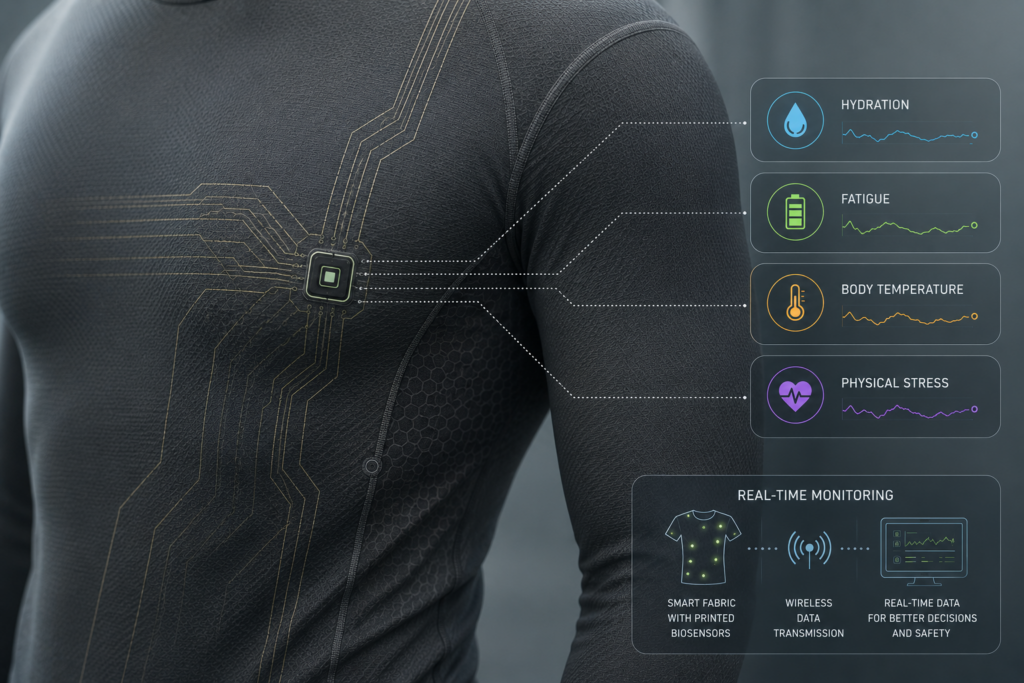
Imagine a uniform capable of continuously monitoring a soldier’s physiological condition during a mission. Flexible printed biosensors integrated into the fabric could track parameters such as hydration, fatigue, body temperature or physical stress, providing real-time information that helps improve decision-making and increase personnel safety.
Once this technology has been developed and validated for one of the world’s most demanding environments, adapting it to civilian applications becomes a natural next step.
The same sensing platform can be integrated into sportswear to monitor athletic performance, into workwear to prevent heat stress in industrial environments, or into healthcare wearables that enable continuous, non-invasive patient monitoring.
The core technology remains the same. What changes is the application.
The same principle applies to many other printed electronic solutions.
Printed strain sensors developed to monitor structural stress in aerospace or defense equipment can later be incorporated into industrial machinery for predictive maintenance. Flexible heating systems initially designed for demanding operational environments can be adapted to electric mobility, battery management or industrial equipment. Printed NFC or RFID technologies developed for secure asset identification can evolve into smart packaging, traceability or authentication solutions.
Rather than creating completely new technologies for every market, dual-use innovation accelerates the transfer of existing knowledge into new industries, reducing development time while increasing the return on innovation.
Thinex’s Vision for Dual-Use Innovation
At Thinex, we believe the future of printed electronics lies in building technologies that are adaptable from the very beginning.
Our work focuses on developing flexible printed sensors, biosensors, heating systems and intelligent surfaces that can be integrated into products where weight, flexibility and functional integration are critical. While many of these technologies have clear potential within defense environments, their value extends far beyond a single sector.
The same printed electronic platform can evolve into solutions for industrial monitoring, healthcare, wearable technologies, aerospace, smart packaging or connected products.
This approach also makes innovation more sustainable. Instead of developing isolated technologies for individual industries, dual-use solutions encourage knowledge transfer across multiple sectors, allowing advances made in one field to generate value in many others.
As industries continue moving toward digitalization, connected products and real-time data, the demand for integrated sensing technologies will continue to grow. Printed electronics provide an efficient way to embed intelligence directly into products without adding unnecessary weight or complexity.
Dual-use technology is not simply about defense.
It is about creating innovations capable of solving challenges across multiple industries.
And as printed electronics continue to mature, they will play an increasingly important role in building products that are not only smarter, but also lighter, more efficient and ready to adapt wherever they are needed.
Plastronics (In-Mold Electronics): Integrating Intelligence Directly into Products
The products around us are becoming increasingly smart. From vehicles and industrial equipment to home appliances and consumer electronics, there is a growing demand for products capable of sensing, communicating, collecting data, and interacting with users.
Traditionally, adding these capabilities required integrating electronic components after the product had been manufactured. Sensors, wiring, connectors, control units, and interfaces are assembled as separate elements, increasing complexity, weight, manufacturing costs, and design limitations.
However, a new generation of technologies is changing this approach.
Plastronics, also known as In-Mold Electronics (IME), enables the integration of electronic functionalities directly into plastic parts, transforming conventional surfaces into smart, connected systems. Instead of adding electronics to a product after it has been manufactured, the electronics become an integral part of the product’s structure.
At Thinex Rotimpres, we are working on the development of new solutions based on these technologies, bringing printed electronics closer to industrial manufacturing and opening up new possibilities in product design, functionality, and sustainability.
What is Plastronics and why is it gaining relevance?
Plastronics is the convergence of plastics and electronics into a single integrated functional structure.
Rather than treating a plastic part as a purely passive mechanical component, Plastronics enables it to perform active functions such as sensing, communication, user interaction, or data collection. This is achieved by integrating electronic elements directly on or within plastic substrates using technologies such as printed electronics.
Its relevance is growing because manufacturers across virtually all sectors face common challenges: developing smarter products, generating more data, reducing weight and volume, simplifying manufacturing processes, and meeting increasingly strict sustainability requirements.
Traditional electronic architectures often make these goals difficult to achieve, since each new function typically requires additional components, wiring, connectors, and assembly operations.
Plastronics offers a different approach. By embedding functionality directly into the product structure, it becomes possible to reduce the number of components, simplify assembly, decrease weight, and create more efficient and compact designs. A plastic surface can become a touch interface. A housing can incorporate lighting or connectivity. A structural component can act as a sensor. In short, products cease to be passive elements and become systems capable of generating information and interacting with their environment.

How Plastronics (In-Mold Electronics, IME) Works
In-Mold Electronics (IME), also referred to as Plastronics in many industrial contexts, enables the integration of electronic functionalities directly into plastic parts during the manufacturing process itself. Both terms are commonly used to describe the integration of circuits and electronic components into three-dimensional plastic structures.
IME combines four industrial processes into a single integrated manufacturing flow: printed electronics, component embedding (hybridization), thermoforming, and injection molding.

The process begins by printing circuits and functional layers onto a flexible substrate using printed electronics technologies. These layers can incorporate sensors, RFID or NFC antennas, heating elements, lighting, or user interface functions.
Electronic components can then be added through hybrid integration processes. Next, the printed structure is three-dimensionally formed through thermoforming to match the final geometry of the part. Finally, the entire assembly is encapsulated within a plastic part using injection molding.
The result is a functional component in which the electronics are fully integrated inside the product.
This approach offers significant advantages over conventional assembly methods. It eliminates wiring and connectors, reduces the number of parts, improves reliability, and increases design freedom. It also enables the creation of smart surfaces capable of incorporating advanced functions without adding complexity to the final product.
Potential applications range from automotive interiors with integrated touch controls to industrial equipment capable of monitoring pressure, temperature, or deformation directly through its own structure.
A market set to transform advanced manufacturing
The growing interest in Plastronics and In-Mold Electronics is not driven solely by a technological trend. It is also supported by a significant market opportunity.
According to forecasts from IDTechEx, the global market for In-Mold Electronics components could exceed 51.8 billion dollars by 2032. The automotive sector is expected to be one of the main growth drivers due to the need for lighter, more intuitive, and more integrated interfaces. However, interest is rapidly expanding into sectors such as consumer electronics, healthcare, industrial applications, aerospace, and smart home appliances.
The ability to integrate functionality directly into surfaces enables manufacturers to develop lighter, more compact, connected, and sustainable products, meeting the demands of the industry of the future.
For this adoption to become a reality, several technical challenges still need to be addressed. During thermoforming and injection molding processes, electronic structures must withstand deformation, temperature changes, and mechanical stress without compromising electrical performance or long-term reliability.
For this reason, Thinex Rotimpres is collaborating with Eurecat on the IMEX (In-Mold Electronics Exploration) project, an initiative focused on developing new materials, functional inks, and manufacturing processes for Plastronics and In-Mold Electronics applications. The goal is to accelerate the industrialization of these technologies and facilitate their integration into lighter, more compact, functional, and efficient products.
The convergence of advanced materials, printed electronics, and industrial processes is redefining the way products are designed and manufactured.
The next generation of smart products will not be built by adding more components. It will be built by embedding intelligence directly into the materials, surfaces, and structures that make them up.
Robots That Can Feel: The Next Step in Industrial Intelligence
Industrial robotics is evolving rapidly. Today’s robotic systems are faster, more precise and increasingly connected, integrating advanced vision systems, artificial intelligence and real-time automation capabilities. Across manufacturing, logistics and Industry 4.0 environments, robots are becoming essential tools for improving efficiency and productivity. However, despite these advances, one important limitation still exists: most robots cannot truly feel what they are doing.
This challenge is driving the development of a new generation of intelligent robotics powered by printed sensors, force sensing technologies and printed electronics. At Thinex Rotimpres, we believe the future of robotics will depend not only on automation and AI, but also on the ability to integrate real-time sensing directly into robotic components and industrial systems.
Why force sensing is becoming essential in robotics
One of the most critical functions in industrial robotics is object handling. Robotic grippers are constantly used to pick, move and manipulate products with precision. Yet most robotic systems still operate using predefined parameters, without fully understanding the amount of force being applied during interaction.
This creates an important limitation. When a robot handles objects with different shapes, materials or fragility levels, applying too much pressure can damage the product, while too little force can compromise grip stability and operational reliability.
For this reason, force sensing is becoming increasingly important in modern robotics.
By integrating sensors capable of measuring pressure, strain or deformation, robots can receive real-time feedback from the interaction itself. Instead of simply executing commands, robotic systems can dynamically adjust their behaviour depending on the object they are handling.
This shift is particularly relevant in industrial automation and collaborative robotics, where systems are expected to become more adaptive, responsive and efficient. As Industry 4.0 continues to evolve, the ability to generate and use real-time data at the component level is becoming a key competitive factor.
How printed electronics enables smarter robotic systems
Traditional sensing technologies often create integration challenges in robotics. Conventional sensors are usually rigid, bulky or difficult to position in areas where physical interaction actually takes place, such as robotic grippers, joints or flexible structures.
This is where printed electronics opens new possibilities.
At Thinex Rotimpres, we develop printed sensors that can be integrated directly into surfaces and components using additive manufacturing processes. Instead of assembling traditional electronic parts, electronic functionalities are printed onto flexible substrates such as plastic films, technical materials or textiles.
This approach enables the development of thin, lightweight and flexible sensing systems that adapt naturally to the geometry of the component. In robotic applications, printed pressure sensors or strain gauges can be integrated directly into the gripping surface, allowing the robot to detect force and deformation exactly where the interaction occurs.
A recent example of this approach was showcased together with Leitat at Advanced Factories, where a printed sensor developed by Thinex was integrated into a robotic gripper. The sensor provided real-time feedback on the force applied by the robot when handling objects, enabling dynamic grip adjustment depending on the interaction.
Even within the constraints of an early-stage integration, the demonstration clearly showed the potential of embedded sensing to improve robotic precision, adaptability and control.
One of the main advantages of printed electronics is that the technology adapts to the product rather than forcing the product to adapt to the technology. This flexibility is especially valuable in next-generation robotics, where integration, scalability and lightweight design are increasingly important.
At Thinex Rotimpres, we see growing interest in printed electronics as industries look for new ways to embed intelligence directly into products and systems without increasing complexity.
The future of robotics is perceptive
The future of industrial robotics will not be defined only by speed or automation. Increasingly, competitive advantage will come from systems capable of sensing, interpreting and responding to real-world conditions in real time.
The convergence of robotics, IoT, artificial intelligence and printed electronics is enabling a new generation of intelligent systems that generate valuable data directly from the point of interaction. Robots are evolving from automated machines into adaptive systems capable of understanding their environment more accurately.
In this context, printed sensors and embedded electronics will play a key role. By integrating sensing capabilities directly into materials and components, printed electronics removes many of the traditional barriers associated with sensor integration and opens the door to more scalable and flexible industrial solutions.
At Thinex Rotimpres, we believe this transformation goes beyond robotics. It reflects a broader shift towards products and systems that are not only functional, but also capable of generating insight and enabling smarter decision-making.
The ability for robots to “feel” may soon become as important as their ability to move.
And this is only the beginning.
The Era of Data-Driven Products: How Printed Electronics Enable Real-Time Intelligence
The shift towards data-driven products is transforming the role of physical goods across industries. What were once static, passive elements are now evolving into intelligent systems capable of generating, transmitting and leveraging data in real time. This evolution is not only redefining how products are designed, but also how companies operate, compete and create value.
Driven by the convergence of IoT, advanced materials and digitalization, products are becoming active participants in digital ecosystems. However, the real disruption goes beyond connectivity. The key lies in the ability to capture meaningful, real-time data directly from products and surfaces, enabling a deeper understanding of performance, usage and context. This shift is turning products into continuous sources of insight, opening new opportunities for optimization, innovation and differentiation.
Why data-driven products are becoming a competitive advantage
Across sectors such as manufacturing, healthcare and logistics, the ability to generate and act on real-time data is rapidly becoming a core competitive factor. Companies are no longer just delivering products — they are delivering data-enabled solutions that evolve over time.
From an operational standpoint, data-driven products allow for continuous monitoring and optimization. Manufacturers can anticipate failures, improve maintenance strategies and reduce inefficiencies by accessing real-time information directly from their products. This leads to better resource management, reduced downtime and more resilient operations.
At the same time, data enables more responsive and personalized user experiences. Products can adapt to environmental conditions, user behavior or specific requirements, creating a more dynamic interaction between product and user.
Sustainability is another key dimension. With increasing regulatory and market pressure, companies need to ensure transparency and efficiency across the entire product lifecycle. Data-driven products enable improved traceability, more efficient use of materials and better lifecycle management. Initiatives such as the Digital Product Passport are accelerating this trend, reinforcing the need for reliable, real-time data embedded within products.
Despite these advantages, a critical challenge remains: how to integrate sensing and data capabilities into products in a way that is scalable, cost-efficient and compatible with existing manufacturing processes.
Printed electronics: enabling real-time data at scale
This is where printed electronics emerges as a key enabling technology.
Unlike traditional electronics, which often rely on rigid components and complex integration processes, printed electronics allows electronic functionalities to be embedded directly onto flexible substrates such as paper, plastic or textiles. This approach enables the seamless integration of intelligence into products without compromising design, cost or scalability.
At Thinex Rotimpres, we develop printed sensors and biosensors that allow companies to capture real-time data directly from products and materials. These technologies enable a wide range of functionalities, from environmental sensing to biochemical detection, all within a flexible and scalable format.
The ability to integrate sensors directly into surfaces opens up new possibilities across industries. In industrial environments, printed sensors can monitor parameters such as temperature, pressure or structural conditions, supporting predictive maintenance and process optimization. In healthcare, biosensors enable new approaches to diagnostics and patient monitoring, particularly in applications where flexibility, comfort and disposability are essential.
In logistics and packaging, printed sensors combined with technologies such as RFID or NFC enable enhanced traceability and condition monitoring. This is particularly relevant in sectors such as food and pharmaceuticals, where ensuring product quality and compliance is critical. By embedding intelligence directly into packaging, companies can gain real-time visibility across the supply chain and improve decision-making.
One of the main advantages of printed electronics is its ability to scale. By leveraging existing industrial processes, it allows for the integration of sensing capabilities into high-volume products in a cost-effective way. This democratizes access to data, enabling a broader range of industries and applications to benefit from data-driven approaches.
From smart products to intelligent ecosystems
As data-driven products become more widespread, the focus is shifting from individual smart products to interconnected systems that generate and exchange data continuously. In this context, products are no longer isolated units, but part of larger ecosystems where data flows across devices, platforms and stakeholders.
This transition requires not only technological capabilities, but also strong collaboration across the value chain. Industry players, technology providers, research centers and innovation clusters all play a role in accelerating adoption and bridging the gap between emerging technologies and real-world applications.
At Thinex Rotimpres, we actively collaborate with organizations such as the Functional Print Cluster to drive the adoption of printed electronics and foster knowledge exchange across the ecosystem. These collaborations are essential to scale innovation and ensure that new technologies translate into tangible industrial impact.
Looking ahead, the ability to transform products into data-generating, intelligent systems will be a defining factor for competitiveness. Companies that successfully integrate sensing, connectivity and data capabilities into their products will be better positioned to optimize operations, enhance user experiences and meet increasing sustainability demands.
Printed electronics is playing a key role in this transformation, enabling a new generation of products that are not only connected, but also capable of generating valuable insights in real time. By embedding intelligence directly into materials and surfaces, it is unlocking new possibilities for innovation and redefining the relationship between products, data and value creation.
At Thinex Rotimpres, we believe this is just the beginning. The era of data-driven products is here — and it is reshaping the future of industry.
The Future of Smart Packaging: Connecting Products, Brands and Consumers
Packaging is no longer just a protective layer — it is becoming a connected, data-enabled interface between products, brands and users. As industries accelerate their digital and sustainability strategies, smart packaging is emerging as one of the fastest-growing and most impactful applications of printed electronics.
What was once static is now interactive. What once only contained is now able to communicate. Thanks to printed RFID and NFC technologies, packaging can now store, transmit and generate valuable information across the entire product lifecycle — from manufacturing and logistics to retail and post-purchase engagement.
This shift is redefining how companies think about packaging: not as a cost center, but as a strategic asset.
From Passive Packaging to Connected Systems
Traditional packaging has always played a functional role: protecting goods, extending shelf life and supporting transport. Over time, it also became a branding surface. Today, it is evolving again — into a connected system layer.
Smart packaging integrates printed electronic components such as RFID and NFC tags directly into labels or substrates. These ultra-thin, flexible elements allow each package to carry a unique digital identity. Unlike conventional barcodes, connected tags can be read wirelessly, without line-of-sight and can store dynamic data.
This creates immediate advantages across the value chain. Manufacturers gain real-time visibility of product flows. Logistics operators improve inventory accuracy and speed. Retailers reduce shrinkage and automate processes. End users can access verified product information with a simple smartphone tap.
The result is a packaging ecosystem that doesn’t just contain products — it communicates with the physical and digital world.
Traceability, Authentication and Operational Efficiency
One of the strongest drivers behind smart packaging adoption is the growing need for traceability and product authentication. Regulatory pressure, sustainability reporting and anti-counterfeiting requirements are pushing brands to identify and track products at unit level.
Printed RFID and NFC tags enable item-level identification at scale. Each product can carry a unique digital record that supports tracking across production, distribution and retail environments. This is especially relevant in sectors such as pharmaceuticals, food, cosmetics and high-value consumer goods, where safety, compliance and authenticity are critical.
Connected packaging also improves operational efficiency. Automated reading reduces manual scanning, minimizes human error and accelerates warehouse and retail operations. Smart tags can support digital product passports, batch tracking and lifecycle data collection — all key elements in the move toward more transparent and circular value chains.
Beyond protection against counterfeiting, authentication also builds trust. When consumers can instantly verify product origin and integrity, brand credibility increases.
Sustainability by Design: The Role of Printed Electronics
As smart packaging grows, sustainability remains a central concern. Adding electronics to packaging only makes sense if it aligns with circular design principles. This is where printed electronics — and specifically additive manufacturing — play a critical role.
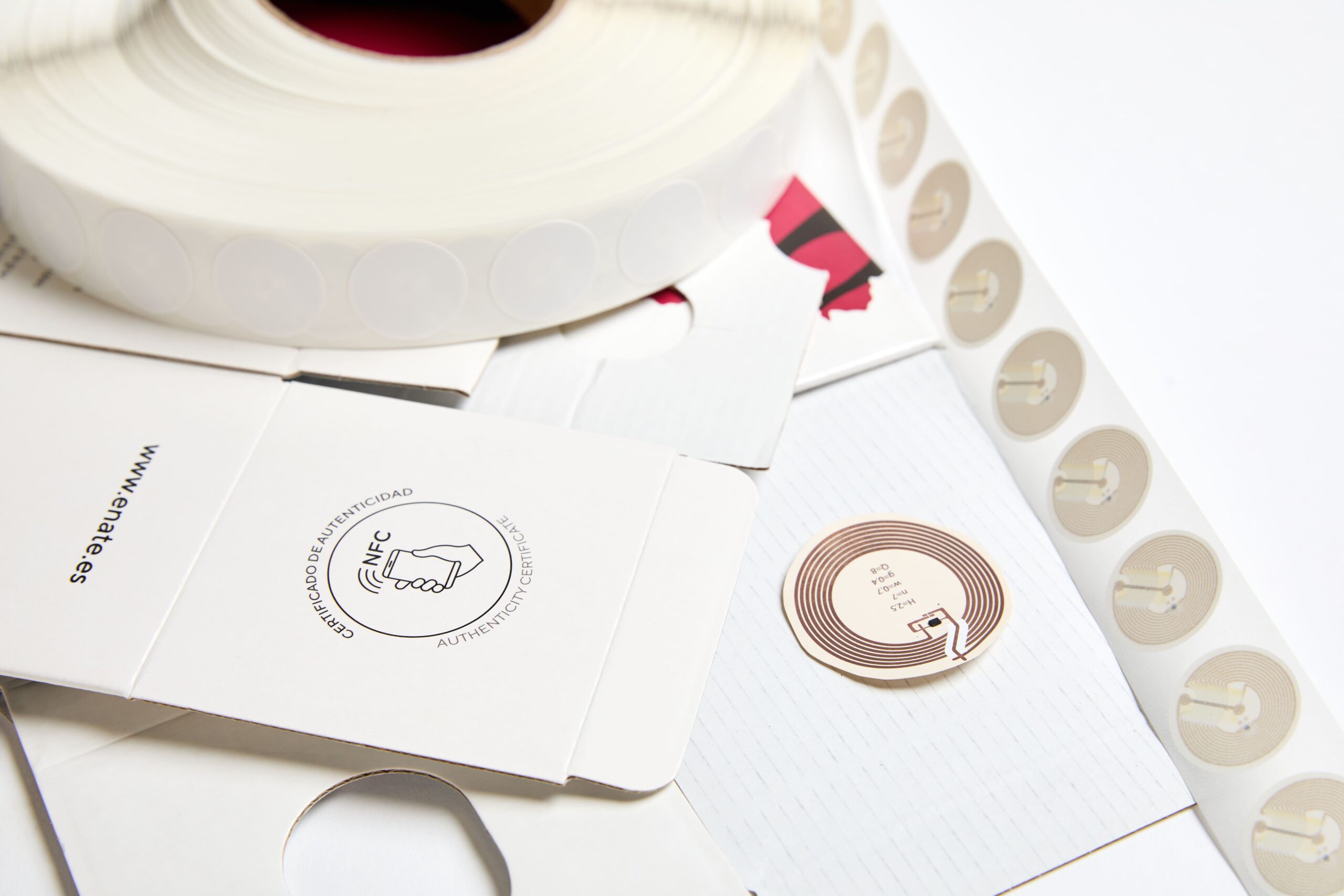
Unlike traditional electronic components, printed RFID and NFC antennas can be produced using minimal material, directly deposited where needed. This reduces waste and process complexity. When combined with paper-based or recyclable substrates, the result is a smart label that maintains performance while reducing environmental impact.
At Thinex Rotimpres, we develop biodegradable and paper-based RFID and NFC tags designed to integrate seamlessly into sustainable packaging solutions. These tags are compatible with recycling streams and help brands replace plastic-heavy alternatives with lower-impact options.
This approach allows companies to add intelligence and connectivity without compromising their ESG and circularity targets. Smart and sustainable no longer need to be opposing goals — they can be engineered together.
Smart Packaging as a Competitive Advantage
What began as a technological innovation is quickly becoming a competitive differentiator. Companies that adopt connected packaging gain better visibility, stronger protection, improved efficiency and richer customer interaction.
Printed electronics make this shift scalable. Ultra-thin, flexible and cost-efficient tags can be integrated into existing packaging formats without major redesign. Additive printing processes support high-volume production while maintaining material efficiency.
At Thinex Rotimpres, we see smart packaging as a convergence point between printed electronics, sustainability and digitalization. By combining advanced printing know-how with functional materials and industrial processes, we help brands and manufacturers move from concept to deployable connected packaging solutions.
To bring these solutions to market at an industrial scale, collaboration across the packaging ecosystem is essential. In this context, we work closely with specialists from the graphic arts and packaging industry, such as Indugraf Group, to explore how smart labels can be effectively integrated into packaging solutions that are both sustainable and scalable. Through this collaboration, we aim to bridge innovation and real-world application, ensuring that these technologies can be implemented efficiently within existing production and distribution systems.
The future of packaging is not just smart — it is connected, traceable and sustainable by design. And as adoption accelerates, smart packaging will move from innovation to expectation across global markets.