
The Future of Smart Packaging: Connecting Products, Brands and Consumers
Packaging is no longer just a protective layer — it is becoming a connected, data-enabled interface between products, brands and users. As industries accelerate their digital and sustainability strategies, smart packaging is emerging as one of the fastest-growing and most impactful applications of printed electronics.
What was once static is now interactive. What once only contained is now able to communicate. Thanks to printed RFID and NFC technologies, packaging can now store, transmit and generate valuable information across the entire product lifecycle — from manufacturing and logistics to retail and post-purchase engagement.
This shift is redefining how companies think about packaging: not as a cost center, but as a strategic asset.
From Passive Packaging to Connected Systems
Traditional packaging has always played a functional role: protecting goods, extending shelf life and supporting transport. Over time, it also became a branding surface. Today, it is evolving again — into a connected system layer.
Smart packaging integrates printed electronic components such as RFID and NFC tags directly into labels or substrates. These ultra-thin, flexible elements allow each package to carry a unique digital identity. Unlike conventional barcodes, connected tags can be read wirelessly, without line-of-sight and can store dynamic data.
This creates immediate advantages across the value chain. Manufacturers gain real-time visibility of product flows. Logistics operators improve inventory accuracy and speed. Retailers reduce shrinkage and automate processes. End users can access verified product information with a simple smartphone tap.
The result is a packaging ecosystem that doesn’t just contain products — it communicates with the physical and digital world.
Traceability, Authentication and Operational Efficiency
One of the strongest drivers behind smart packaging adoption is the growing need for traceability and product authentication. Regulatory pressure, sustainability reporting and anti-counterfeiting requirements are pushing brands to identify and track products at unit level.
Printed RFID and NFC tags enable item-level identification at scale. Each product can carry a unique digital record that supports tracking across production, distribution and retail environments. This is especially relevant in sectors such as pharmaceuticals, food, cosmetics and high-value consumer goods, where safety, compliance and authenticity are critical.
Connected packaging also improves operational efficiency. Automated reading reduces manual scanning, minimizes human error and accelerates warehouse and retail operations. Smart tags can support digital product passports, batch tracking and lifecycle data collection — all key elements in the move toward more transparent and circular value chains.
Beyond protection against counterfeiting, authentication also builds trust. When consumers can instantly verify product origin and integrity, brand credibility increases.
Sustainability by Design: The Role of Printed Electronics
As smart packaging grows, sustainability remains a central concern. Adding electronics to packaging only makes sense if it aligns with circular design principles. This is where printed electronics — and specifically additive manufacturing — play a critical role.
Unlike traditional electronic components, printed RFID and NFC antennas can be produced using minimal material, directly deposited where needed. This reduces waste and process complexity. When combined with paper-based or recyclable substrates, the result is a smart label that maintains performance while reducing environmental impact.
At Thinex Rotimpres, we develop biodegradable and paper-based RFID and NFC tags designed to integrate seamlessly into sustainable packaging solutions. These tags are compatible with recycling streams and help brands replace plastic-heavy alternatives with lower-impact options.
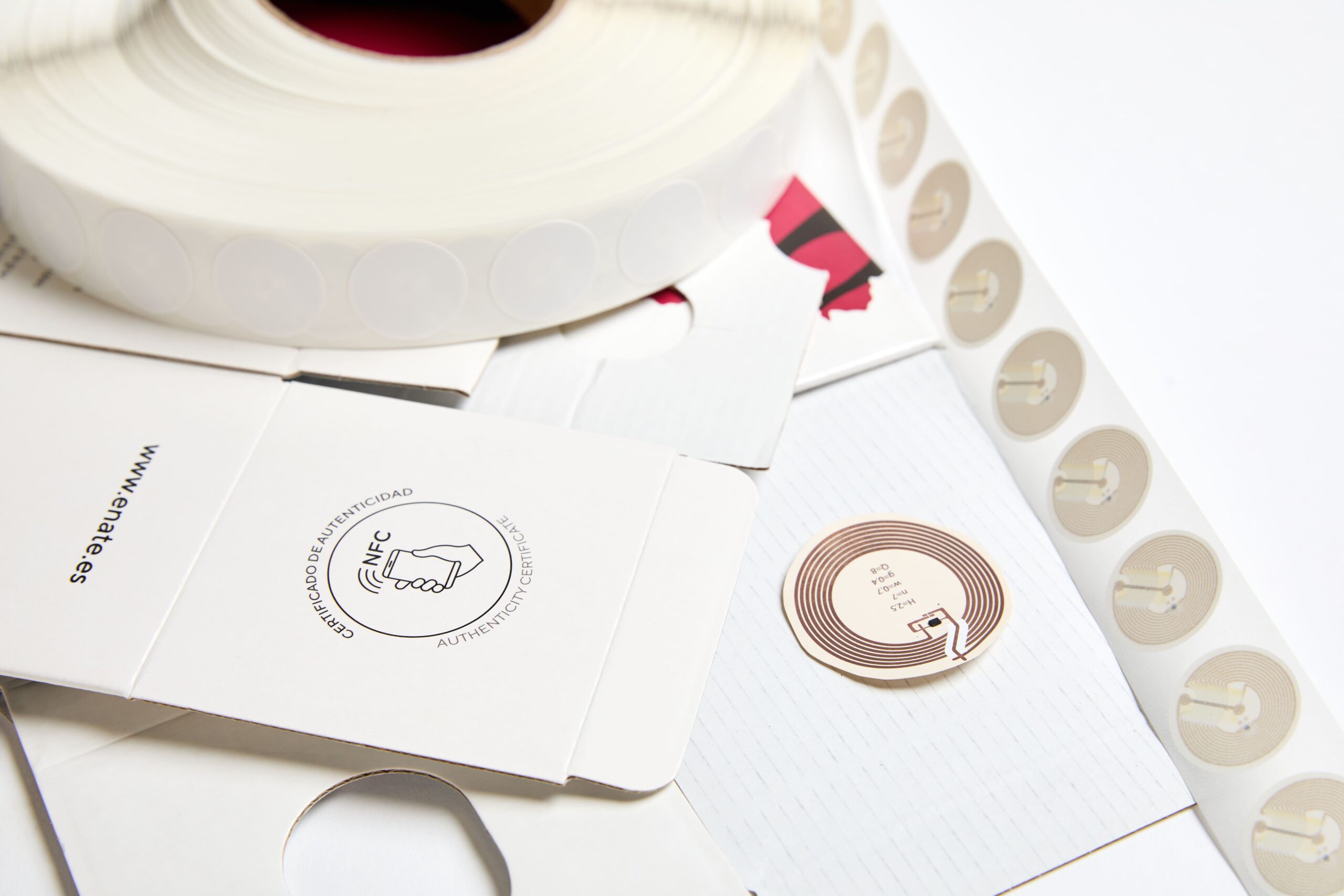
This approach allows companies to add intelligence and connectivity without compromising their ESG and circularity targets. Smart and sustainable no longer need to be opposing goals — they can be engineered together.
Smart Packaging as a Competitive Advantage
What began as a technological innovation is quickly becoming a competitive differentiator. Companies that adopt connected packaging gain better visibility, stronger protection, improved efficiency and richer customer interaction.
Printed electronics make this shift scalable. Ultra-thin, flexible and cost-efficient tags can be integrated into existing packaging formats without major redesign. Additive printing processes support high-volume production while maintaining material efficiency.
At Thinex Rotimpres, we see smart packaging as a convergence point between printed electronics, sustainability and digitalization. By combining advanced printing know-how with functional materials and industrial processes, we help brands and manufacturers move from concept to deployable connected packaging solutions.
To bring these solutions to market at an industrial scale, collaboration across the packaging ecosystem is essential. In this context, we work closely with specialists from the graphic arts and packaging industry, such as Indugraf Group, to explore how smart labels can be effectively integrated into packaging solutions that are both sustainable and scalable. Through this collaboration, we aim to bridge innovation and real-world application, ensuring that these technologies can be implemented efficiently within existing production and distribution systems.
The future of packaging is not just smart — it is connected, traceable and sustainable by design. And as adoption accelerates, smart packaging will move from innovation to expectation across global markets.