
Dual-Use Technology: How Defense Innovation Creates Civilian Solutions
Innovation rarely stays within the industry where it was first developed. Throughout history, many of the technologies we use every day—from GPS and the internet to advanced materials and satellite communications—were originally created for defense applications before finding their way into the civilian world.
Today, the same transformation is happening with printed electronics.
As governments and industries invest in smarter, lighter and more connected defense systems, the technologies developed to meet these demanding requirements are creating new opportunities across healthcare, industry, mobility and consumer products. This is known as dual-use technology: innovations designed for defense that can later be adapted for commercial and industrial applications.
At Thinex, we see printed electronics as one of the key enabling technologies behind this transition, allowing advanced sensing, connectivity and intelligence to move seamlessly from mission-critical environments into everyday products.
Why Printed Electronics are a natural fit for dual-use applications
Defense systems demand technologies that are lightweight, reliable, energy-efficient and capable of operating in harsh environments. Conventional electronics often struggle to meet these requirements because they rely on rigid components, complex assemblies and additional wiring.
Printed electronics offer a fundamentally different approach.
Instead of attaching electronic devices onto a product, conductive and functional inks are printed directly onto flexible substrates, creating sensors, antennas, heaters and electronic circuits that become part of the product itself.
This enables manufacturers to develop solutions that are:
- Extremely lightweight.
- Flexible and conformable to complex surfaces.
- Easy to integrate into textiles, composites or plastic components.
- Scalable for industrial manufacturing.
- Designed with fewer components and simpler assembly.
These characteristics make printed electronics particularly attractive for defense applications, where reducing weight, improving durability and increasing functionality can directly impact operational performance.
But the same characteristics are equally valuable in civilian markets.
A technology capable of improving the safety and efficiency of a soldier can often be adapted to improve the safety, health or productivity of workers, athletes or patients.
This ability to transfer innovation across sectors is what makes dual-use technology so powerful.
One Technology, Multiple Markets
One of the clearest examples is wearable sensing.
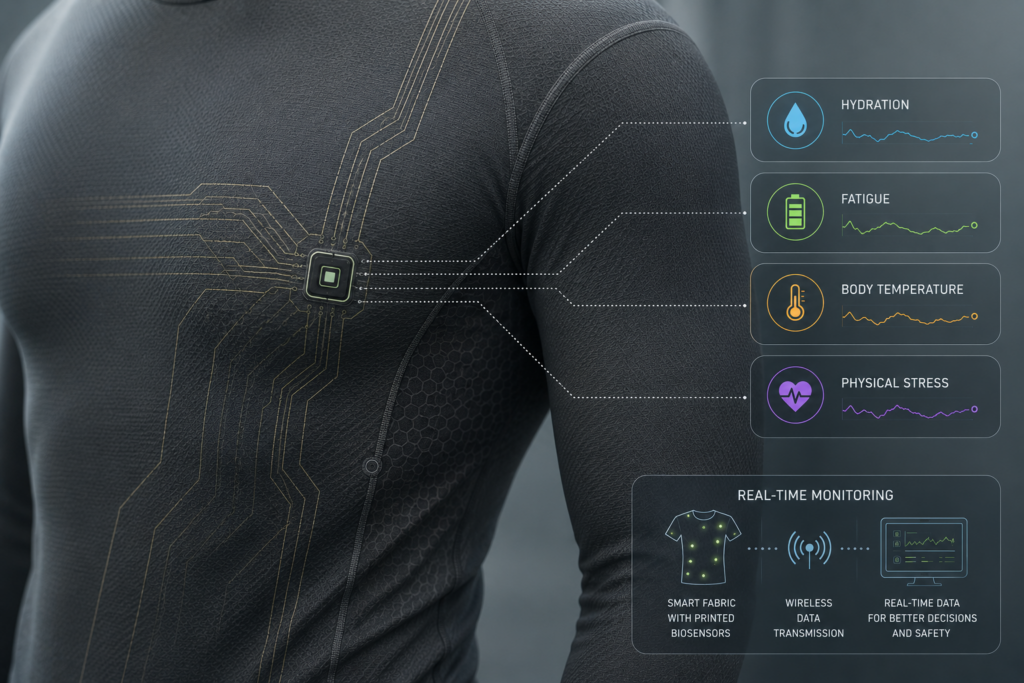
Imagine a uniform capable of continuously monitoring a soldier’s physiological condition during a mission. Flexible printed biosensors integrated into the fabric could track parameters such as hydration, fatigue, body temperature or physical stress, providing real-time information that helps improve decision-making and increase personnel safety.
Once this technology has been developed and validated for one of the world’s most demanding environments, adapting it to civilian applications becomes a natural next step.
The same sensing platform can be integrated into sportswear to monitor athletic performance, into workwear to prevent heat stress in industrial environments, or into healthcare wearables that enable continuous, non-invasive patient monitoring.
The core technology remains the same. What changes is the application.
The same principle applies to many other printed electronic solutions.
Printed strain sensors developed to monitor structural stress in aerospace or defense equipment can later be incorporated into industrial machinery for predictive maintenance. Flexible heating systems initially designed for demanding operational environments can be adapted to electric mobility, battery management or industrial equipment. Printed NFC or RFID technologies developed for secure asset identification can evolve into smart packaging, traceability or authentication solutions.
Rather than creating completely new technologies for every market, dual-use innovation accelerates the transfer of existing knowledge into new industries, reducing development time while increasing the return on innovation.
Thinex’s Vision for Dual-Use Innovation
At Thinex, we believe the future of printed electronics lies in building technologies that are adaptable from the very beginning.
Our work focuses on developing flexible printed sensors, biosensors, heating systems and intelligent surfaces that can be integrated into products where weight, flexibility and functional integration are critical. While many of these technologies have clear potential within defense environments, their value extends far beyond a single sector.
The same printed electronic platform can evolve into solutions for industrial monitoring, healthcare, wearable technologies, aerospace, smart packaging or connected products.
This approach also makes innovation more sustainable. Instead of developing isolated technologies for individual industries, dual-use solutions encourage knowledge transfer across multiple sectors, allowing advances made in one field to generate value in many others.
As industries continue moving toward digitalization, connected products and real-time data, the demand for integrated sensing technologies will continue to grow. Printed electronics provide an efficient way to embed intelligence directly into products without adding unnecessary weight or complexity.
Dual-use technology is not simply about defense.
It is about creating innovations capable of solving challenges across multiple industries.
And as printed electronics continue to mature, they will play an increasingly important role in building products that are not only smarter, but also lighter, more efficient and ready to adapt wherever they are needed.